Career Journey
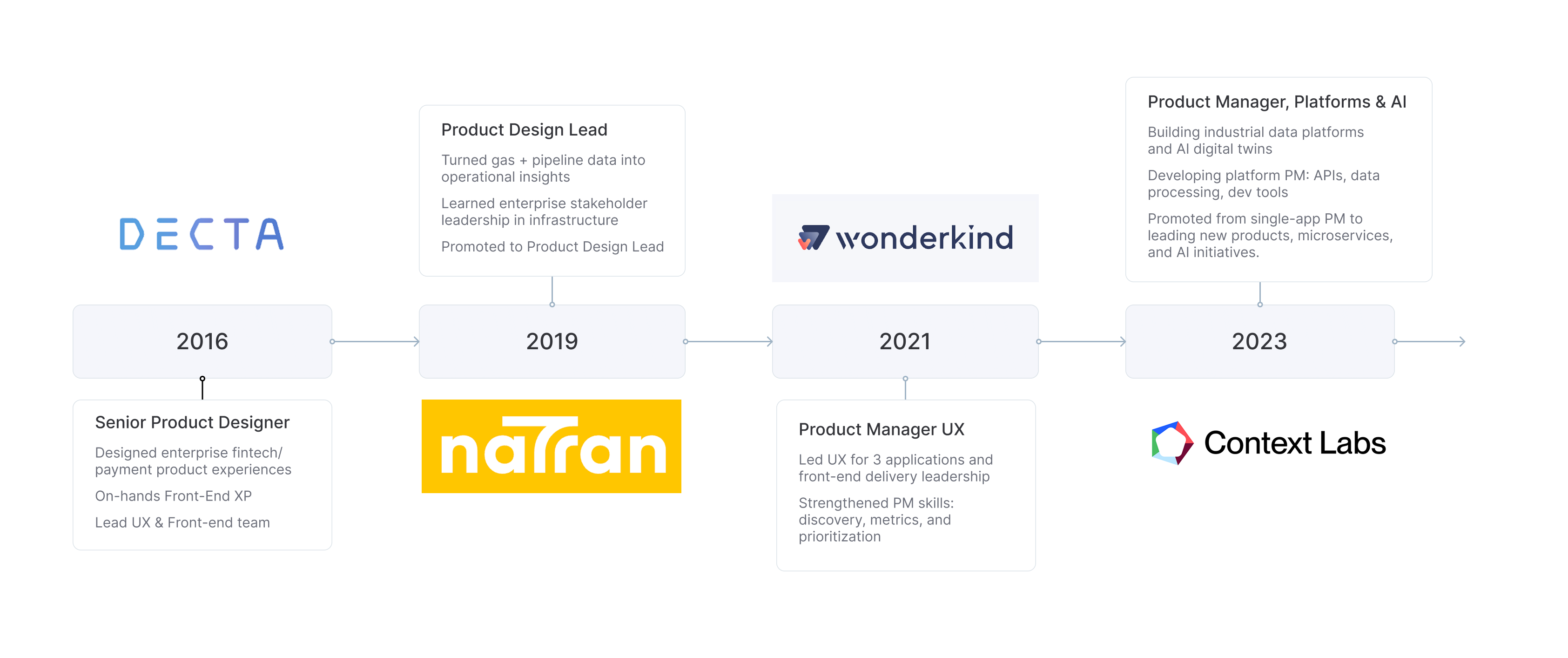
From product design across defence (ELEKS), EU fintech (DECTA, 27 countries) and energy infrastructure (GRTgaz, Germany) to applied AI products at Context Labs, interface included.
A rare pair: I build the evidence layer of industrial AI, and the exceptional interface that makes it legible. Refinery methane reporting, upstream-gas asset graphs, ammonia-plant emissions: three products in production at Context Labs in 2026, front-end designed and built by me, on a knowledge graph with provenance on every record. Twelve years of making dense, live, consequential data readable: defence consoles, a payments platform across 27 countries, gas-pipeline control rooms. Since November 2026, one layer down: evaluation and model training, logged in the open.
Where a refinery's SCADA history, LDAR surveys and device registers become an OGMP 2.0 submission: agents that report, profile and distil, and every figure traced to its source.
The workbench for the graph under everything: well pads, wellheads, meters, events and surveys as linked records, laid out, filtered and edited in the browser.
An ammonia plant on satellite imagery, process areas and emission sources as layers, production, CO₂e and intensity per period, with CSV export for the report.
Exceptional UI for dense, live, consequential data.
So every answer can be checked, not just trusted.
Most teams hire two people for this. I'm the one who notices when the interface misrepresents the model, and when the model misleads the interface.
Started 9 November 2026. Entries are dated, state what done looks like, and flip to a result only when there is one. Nothing here is a claim until it carries a date and a link.
Goal: measurable factuality, provenance correctness and refusal on missing data, on the ammonia and carbon-capture Context Packages.
Done looks like: a held-out question set with graded answers, a scorecard per package version, and a short report on failure classes.
Status: scoping with the Data Science directors.
Goal: own one iteration end to end: label curation, held-out evaluation, error analysis, and a fine-tune of an open VLM that classifies or describes corrosion and metal-loss findings.
Done looks like: a model card, an eval table, ablations and a short report.
Note: the production image model is the team's work. This entry covers the iteration I will run myself.
Goal: supervised fine-tuning plus preference tuning of a 1–8B open model that maps source tables and columns to ontology classes, benchmarked against a frontier model on accuracy, latency and cost.
Done looks like: a dataset card, the training config, the eval, and a cost-latency chart.
Goal: PyTorch and transformers from first principles, one LoRA fine-tune end to end on a rented GPU, and one two-GPU DDP run.
Done looks like: a public repo with the run, the loss curves, and what broke.
From product design across defence (ELEKS), EU fintech (DECTA, 27 countries) and energy infrastructure (GRTgaz, Germany) to applied AI products at Context Labs, interface included.